

10 Jun, 2026
Most factories don’t become “smart” overnight. It usually starts with small frustrations. Machines stop without warning. Operators struggle to find the right data. Production reports arrive too late to be useful. Maintenance teams spend more time reacting than preventing problems.
Maybe you’ve felt this too. Many people tell us they don’t need flashy technology. They simply want their factory to run smoothly, safely, and predictably. That’s where US standard panels often become part of the conversation.
As a US Standard Panel Supplier in Gujarat, Nikka INC. works with manufacturers who want stronger control systems, cleaner integration, and better reliability as they move toward smart manufacturing.
Industry 4.0 sounds technical, but the idea is simple. Machines, sensors, software, and people work together in real time. Instead of waiting for end-of-day reports, factory teams can see what is happening right now. That visibility helps manufacturers:
See performance and issues as they happen.
Identify problems before they become major breakdowns.
Monitor consumption and reduce waste.
Use data and automation to reduce variation.
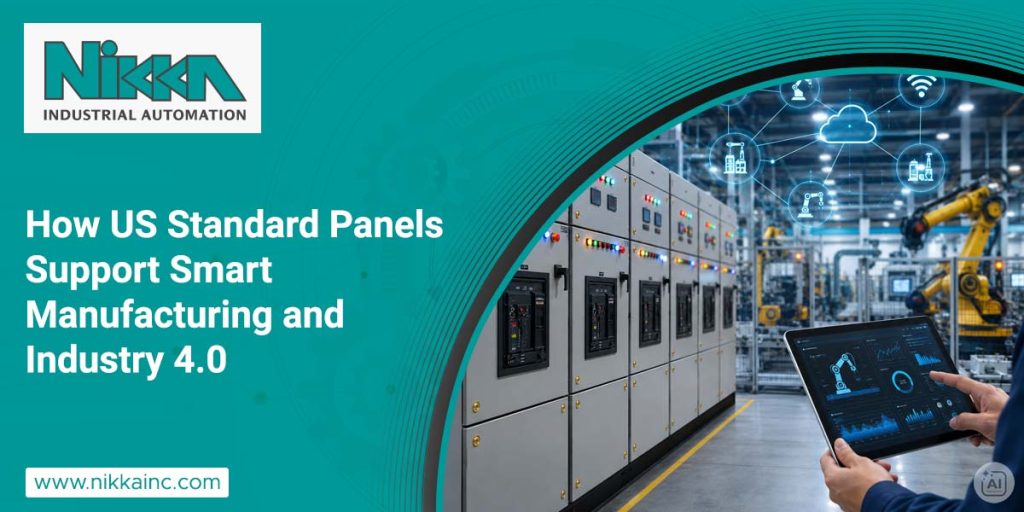
To make all of this work, the control panel becomes the nervous system of the factory. It connects field devices, PLCs, drives, sensors, SCADA systems, and enterprise software. If the panel is poorly designed, the entire system becomes harder to maintain and scale.
US standard panels are designed to meet recognised electrical and safety practices that are widely accepted across global industrial projects. For manufacturers, this brings several practical benefits.
Factories often grow over time. New machines are added, old systems are upgraded, and production lines change. Standardised panel design helps keep electrical systems organised and easier to understand.
Safety is not only about compliance documents. Clear wiring practices, proper protection devices, and reliable enclosure design help reduce risks during operation and maintenance.
Modern factories rarely use equipment from a single vendor. Standardised panels make it easier to integrate different automation platforms and communication networks.
When systems follow recognised standards, troubleshooting becomes faster. Replacement parts, documentation, and future upgrades are easier to manage.
The move toward smarter manufacturing is happening worldwide. According to Grand View Research, the global smart factory market was valued at about USD 154.9 billion in 2024 and is expected to grow strongly through 2030.
(Source: Grand View Research)
Industry surveys also show that manufacturers are actively investing in smart factory initiatives to improve efficiency, quality, and customer satisfaction.
We’re seeing this shift across industries such as automotive, pharmaceuticals, food processing, chemicals, packaging, and general manufacturing. Companies are no longer asking whether digitalisation matters. They’re asking how to implement it without disrupting production.
Smart manufacturing depends on accurate data. A well-designed panel gathers signals from sensors, drives, motors, and instruments, then sends that information to PLCs and SCADA systems. This allows operators to monitor:
Many breakdowns show warning signs before failure. Temperature changes, vibration, current draw, and pressure variations can indicate developing problems.
With proper panel integration, these signals can be monitored continuously. Maintenance teams can act before a machine stops unexpectedly.
Plant managers do not always need to be physically present to understand what is happening. Connected control systems allow authorised users to view production data, alarms, and trends remotely.
This became especially valuable when companies needed better visibility across multiple sites.
Customer demands change quickly. Manufacturers often need to switch products, packaging, or production schedules faster than before.
Modern automation panels support programmable control strategies that make these changes easier to manage.
Energy costs remain a major concern for industrial facilities. Smart panels can monitor power usage and help identify waste, inefficient equipment, and peak demand issues.
Even small improvements in energy efficiency can create meaningful savings over time.
For many years, we have worked with factories that need reliable automation infrastructure, not just individual components.
Nikka INC. was established in 1997 and brings more than 30 years of experience in industrial automation, motion control, CNC control, SCADA systems, process instrumentation, and electrical control panels. We support turnkey automation projects across a wide range of industries.
As a US Standard Panel Supplier in India, we focus on building systems that are practical, maintainable, and ready for future expansion. Many of our customers start with a single line upgrade and gradually move toward broader Industry 4.0 adoption.
We also work as a US Standard Panel Supplier in Gujarat for projects that require adherence to recognised international practices. Our teams understand that manufacturers need solutions that fit real production environments, not laboratory conditions.
One thing we’ve learned is that smart manufacturing is not only about technology. It’s also about helping people work with less stress.
When operators have clear information, maintenance teams can plan ahead, and managers can make decisions based on real data; the entire plant runs more smoothly. Problems are found earlier. Downtime becomes easier to control. Teams spend less time chasing issues and more time improving performance. That is often the real value of a smart factory.
The demand for connected, data-driven manufacturing will continue to grow. Analysts project strong expansion in both the smart factory and smart manufacturing markets over the coming years.
For manufacturers planning that transition, the control panel remains one of the most important building blocks. A reliable panel provides the foundation for connectivity, automation, monitoring, and future upgrades.
As a US Standard Panel Distributor in Vadodara and a US Standard Panel Manufacturer in India, Nikka INC. continues to help factories build that foundation with practical automation solutions that support long-term growth.
Smart manufacturing does not have to start with a complete transformation. Sometimes it begins with one well-designed panel that helps a factory see, control, and improve its operations more effectively.
If your machines face frequent downtime, poor communication, or limited monitoring, it may be time to upgrade. A trusted US Standard Panel Supplier in Gujarat can help assess your current system and identify gaps.
Yes. Most modern panels are designed to connect with PLCs, SCADA systems, drives, and field devices. An experienced US Standard Panel Supplier in India can help integrate them with your current setup.
Yes. These panels support real-time monitoring and data collection, helping teams spot issues before they become major failures. A reliable US Standard Panel Supplier in Gujarat can help improve system visibility.
Absolutely. Smart manufacturing is not limited to large plants. A dependable US Standard Panel Distributor in Vadodara can provide solutions that match your production needs and budget.
Look for experience, technical support, compliance knowledge, and proven project delivery. A trusted US Standard Panel Manufacturer in India should understand both current requirements and future expansion plans.
They create a strong base for data sharing, automation, remote monitoring, and predictive maintenance. Working with a qualified US Standard Panel Supplier in Gujarat helps factories move toward smarter operations with confidence.

