

10 Jun, 2026
You might have felt like when everything in the plant is running well, production is on schedule, and operators are confident, suddenly one small controller failure brings an entire process to a halt. It usually starts with something small like a hardware fault, a communication issue, or a processor failure, yet the impact can be huge. Production stops, operators scramble to respond, and every minute of downtime starts costing money.
This is exactly why many industries now invest in redundancy. As a Hot Redundant PLC System Manufacturer in Vadodara, we have seen how one fast switchover can prevent hours of disruption and stress. At NIKKA INC., we often speak with plant managers who have already experienced unexpected shutdowns. Most of them tell us the same thing: they never realised how much they depended on a single controller until it failed.
Most people think downtime only affects production numbers. The reality is much bigger. A recent study by Fluke found that manufacturers across the UK, US, and Germany face frequent downtime incidents, with some outages lasting up to 72 hours. The research also reported an average downtime cost of £1.36 million per hour in large operations. Those numbers are hard to ignore.
But beyond the financial impact, downtime creates pressure across the entire facility. Operators lose visibility. Maintenance teams rush to identify faults. Delivery schedules slip. Customer confidence can suffer. That is why reliability is no longer viewed as a nice feature. It has become a basic requirement.
Many people hear the word “redundancy” and assume it simply means having a backup controller. The reality is much more interesting.
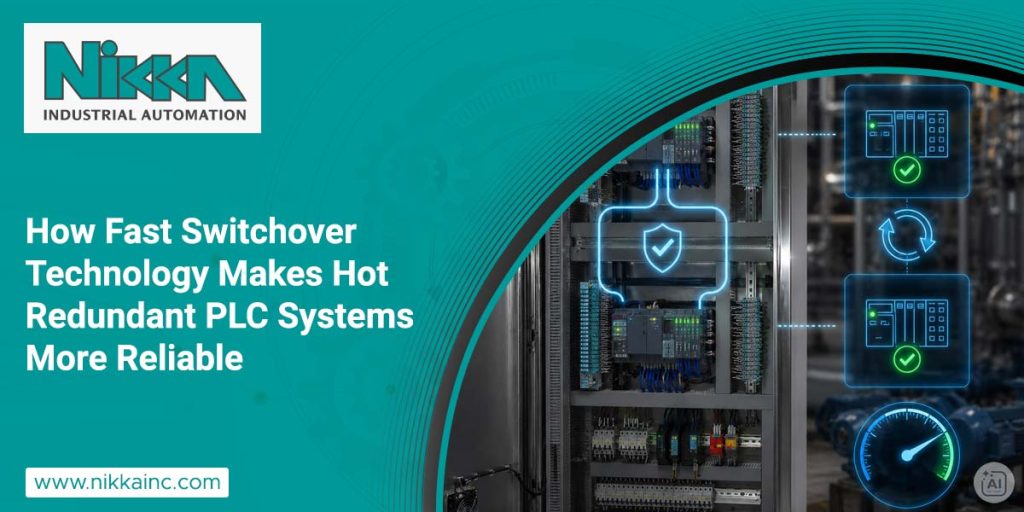
A hot redundant PLC system uses two processors working together. One processor actively controls the process, while the second processor constantly mirrors every action and every piece of data in real time. If the active processor fails, the standby processor immediately takes control. The goal is simple. The process should continue running without operators noticing a disruption.
As a Hot Redundant PLC System Distributor in India, we often explain that redundancy is not about reacting to failure. It is about making sure failure never interrupts the process in the first place.
Not all redundant systems perform the same way. The real value comes from how quickly the standby processor takes over. Imagine a refinery process where temperatures must remain stable. Or a pharmaceutical line where product quality depends on precise control. Even a brief interruption can create problems. Fast switchover technology reduces this risk.
Modern hot standby systems continuously share logic execution, memory data, and communication status. If the primary processor develops a fault, the secondary processor already knows exactly what is happening inside the system. It can assume control almost instantly.
Many people tell us they expected a noticeable delay during switchover. In well-designed systems, that delay is often so small that the process continues without any visible disturbance.
When people discuss automation, they often focus on equipment. Operators see things differently. They care about confidence. When operators know the control system can survive a processor failure, they work with greater peace of mind. They spend less time worrying about unexpected shutdowns and more time focusing on process performance.
At NIKKA INC., we have seen this happen often. Plants that upgrade to redundant control systems frequently report fewer emergency interventions and fewer late-night troubleshooting calls. That confidence becomes valuable over time.
A processor is only one part of the system. True reliability comes from protecting every critical area. A well-designed redundant system may include:
Research into PLC redundancy shows that system reliability improves when redundancy exists at multiple levels rather than only at the processor level. As a Redundant PLC Panel Distributor in India, we encourage customers to think about the entire control architecture, not just the controller itself.
Some industries can tolerate a brief interruption. Others cannot. Power generation plants, chemical processing units, water treatment facilities, pharmaceutical manufacturers, and oil and gas operations often require uninterrupted control.
A few seconds of lost control can trigger alarms, safety concerns, product loss, or process instability. This is why hot redundancy has become common in these sectors. At NIKKA INC., we work with facilities where reliability is directly linked to safety and compliance. In these environments, maintaining control during equipment failure is not optional. It is essential.
People sometimes see redundancy as an expensive insurance policy. We’ve seen it differently. Most clients who invest in redundancy are not trying to prepare for a disaster. They are trying to avoid the daily uncertainty that comes with ageing equipment and critical production demands.
Many people tell us they sleep better knowing there is a backup controller ready to take over. That may sound simple, but anyone responsible for plant operations understands exactly what that means. A reliable control system removes a layer of worry from every shift.
Technology alone does not guarantee reliability. System design, panel engineering, testing, commissioning, and long-term support all play a role. As a Redundant PLC Panel Supplier in India, we have learned that even the best hardware can underperform if the architecture is not designed correctly.
That is why every project requires careful planning. Processor synchronisation, network design, communication paths, and fault recovery testing all need attention before the system goes live. At NIKKA INC., we focus on creating systems that perform reliably under real plant conditions, not just during demonstrations.
Industrial automation continues to become more connected and more demanding. Production targets are higher. Downtime costs are increasing. Expectations for reliability continue to grow.
Studies on redundancy and fault-tolerant control systems continue to show that backup architectures play a major role in maintaining stable operations.
As a Hot Redundant PLC System Supplier in India, we believe fast switchover technology will remain one of the most important features in critical automation systems. The reason is simple.
Failures will always happen. Hardware ages. Components fail. Communication paths experience faults. What matters is what happens next.
Most people never notice a successful switchover, and that is exactly the point. The production line keeps running. Operators keep working. Customers receive their orders. The plant stays productive. That quiet reliability is what makes hot redundancy so valuable.
As a Hot Redundant PLC System Manufacturer in India, NIKKA INC. has spent decades helping industries build control systems that continue performing when unexpected faults occur. With more than 30 years of experience in industrial automation, motion control, SCADA, CNC control, process instrumentation, and electrical control panel manufacturing, NIKKA INC. understands that reliability is not measured when everything works perfectly. It is measured when something goes wrong, and the process keeps running anyway.
A single PLC failure can stop production and cause costly downtime. A Hot Redundant PLC System Manufacturer in Vadodara provides systems that keep operations running even when one controller fails.
Modern systems can switch almost instantly. A trusted Hot Redundant PLC System Supplier in India designs solutions that reduce process interruptions and help maintain stable plant operations.
Power plants, water treatment facilities, chemical plants, and pharmaceutical units often depend on continuous operation. A Hot Redundant PLC System Manufacturer in India helps these industries avoid unexpected shutdowns.
Yes. A properly designed redundant system helps maintain process control during faults. A reliable Redundant PLC Panel Supplier in India can reduce operational risks and improve system availability.
Look at processor redundancy, network design, power backup, and future expansion needs. A knowledgeable Redundant PLC Panel Distributor in India can help match the system to your plant requirements.
When the main controller fails, the backup controller immediately takes over. A trusted Hot Redundant PLC System Distributor in India helps businesses reduce downtime and protect productivity.

